








Much of what we think we know about St Patrick comes from legend rather than history. Check out these ten facts which offer surprising insights into the man behind the myths.
1. Patrick wasn’t Irish
In fact, he was born on the west coast of Britain, probably in Scotland or Wales, and was captured by Irish pirates and taken to Ireland as a slave when he was about 16. Although he found his way back to Britain, he eventually returned to Ireland to convert the Irish to Christianity.
2. Patrick wasn’t his real name
His parents gave him the name Maewyn and his family name was Succat. After being kidnapped and taken to Ireland, Maewyn escaped and returned to his family in Britain. It was then that he decided to devote himself to Christianity and took the Latin name Patricius meaning father figure.
3. Patrick’s writings still exist
When he was a bishop in Ireland, Patrick wrote two open letters, the Confessio and the Epistola. These writings give rare insights into Patrick’s life, thoughts and character. The earliest surviving copy of the Confessio is in the ninth-century Book of Armagh held at Trinity College Dublin, Ireland’s oldest university.
4. Patrick walked more than 200 miles across Ireland to escape slavery
After hearing a voice in a dream telling him his ship was ready, the young Patrick walked from the west coast of Ireland to the east coast to escape slavery returning to Britain. The detail is in his Confessio where he says he walked ‘two hundred thousand (double) paces’, a pace being a Roman measurement.
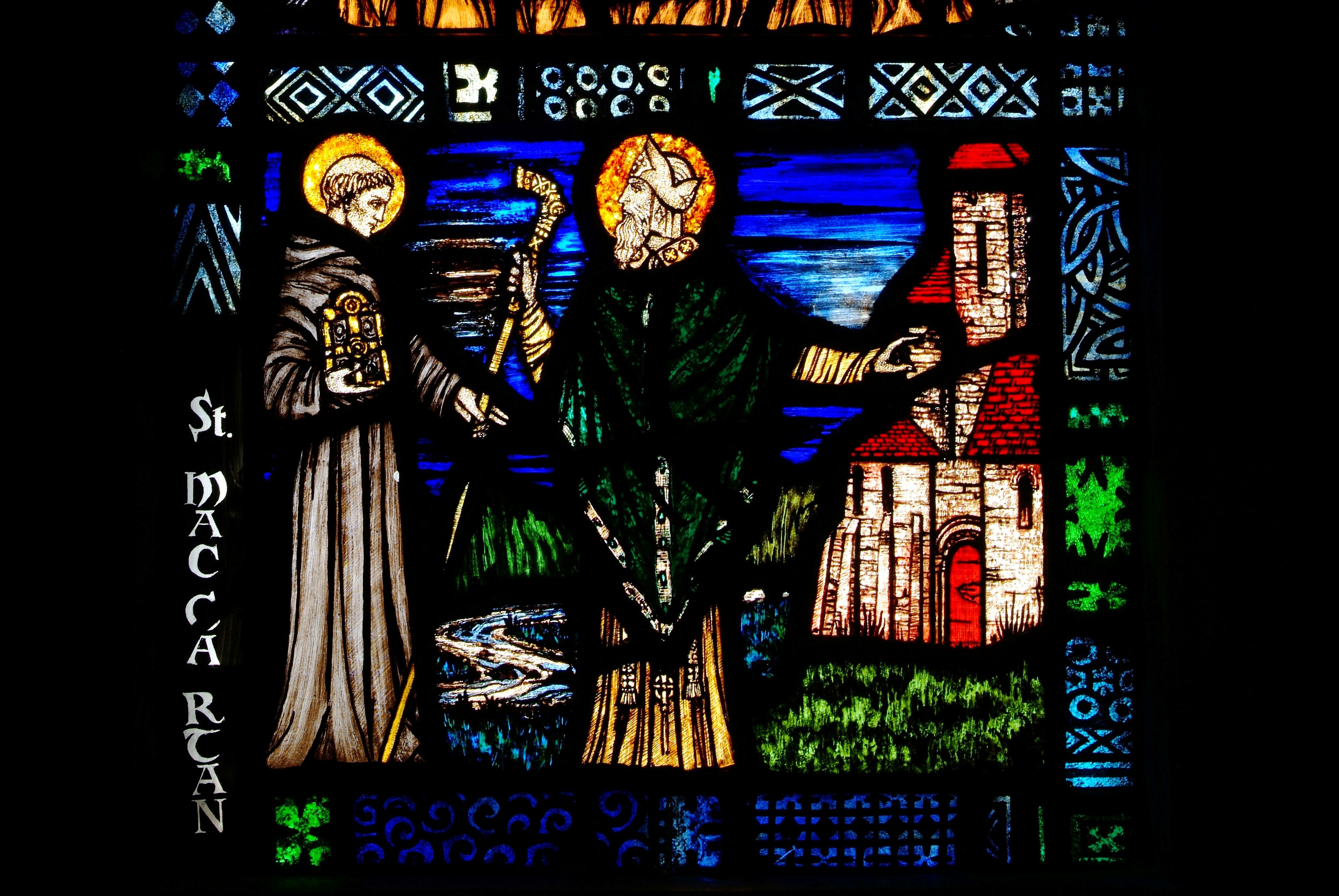
Stained Glass Window at St Patrick’s Cathedral, Armagh
5. Patrick didn’t banish snakes from Ireland
The truth is simply that there were never any snakes in Ireland! It has been suggested that, as snakes were sacred to the pagan Celts, the story is symbolic and is really about Patrick banishing paganism from Ireland.
6. Patrick studied Christianity in France
Although he refers to himself in his Confessio as ‘unlearned’, Patrick studied Christianity in Gaul (France) for more than a decade – training in Auxerre, Tours and Lérins. It was there that he was ordained a priest before he was called in a dream to return to Ireland.
7. Patrick is said to have founded hundreds of churches
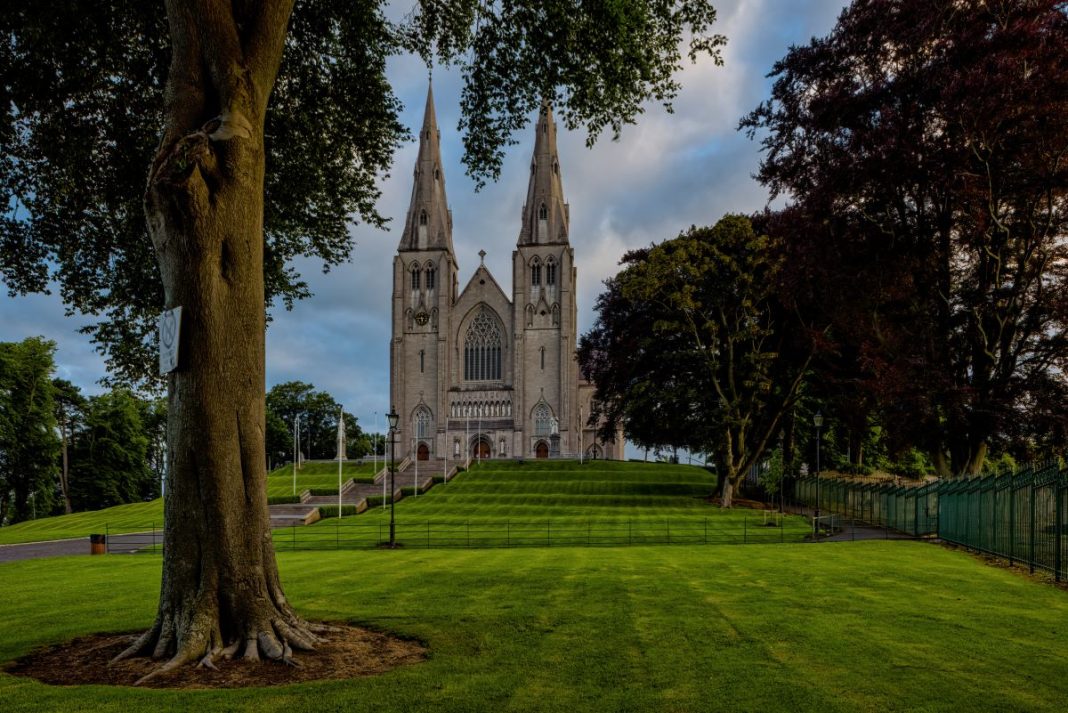
Patrick spent over 40 years as a priest and then bishop in Ireland and is credited with founding over 300 churches and baptising some 100,000 people. Among the churches that are said to have been founded by him are Saul Church in Downpatrick, which is built on the site of Patrick’s earliest place of Christian worship in Ireland, and Armagh Cathedral, built on the site of a stone church dating to AD 445.
8. Patrick was originally associated with the colour blue
St Patrick’s feast day was established by the Catholic Church in the 17th century, and at that time blue was considered to be the colour of Ireland. There is even a colour called St Patrick’s Blue. It was later when green became associated with Irish nationalism that the change came and now one of the traditions on St Patrick’s Day is the “wearing of the green”.
9. The first St Patrick’s Day parade was held in America
Emigrants from Ireland to America began the tradition of St Patrick’s Day parades as a means of celebrating ‘the old country’. Both Boston and New York had parades as far back as 1737 and 1762 respectively. However, recent research has suggested the city of St Augustine in Florida had one in 1601! Parades in Ireland did not take place until the twentieth century, with the first parade occurring in Waterford in 1903.
10. St Patrick’s Day is the most widely celebrated national festival in the world
It’s claimed that mor than 200 countries, from Argentina to Russia, have some form of official celebration on St Patrick’s Day. That’s not surprising given that the Irish diaspora numbers around 80 million people. And it means that wherever you are in the world on March 17th, you’ll probably find a celebration of St Patrick and Irish culture that you can join in.